


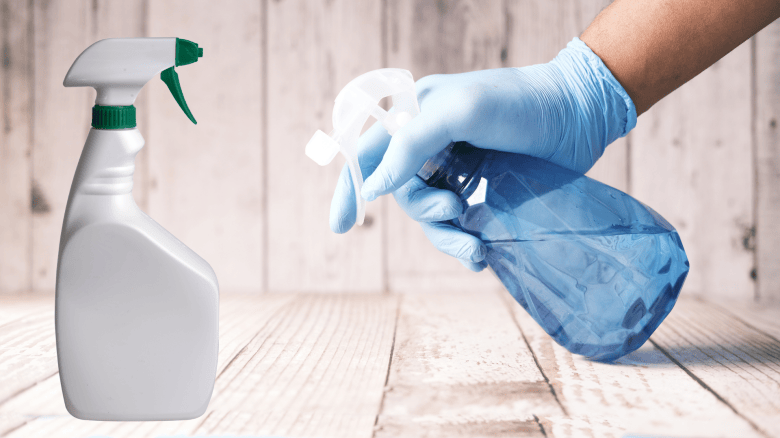
You’d never dream of swallowing Lysol or another disinfectant cleaner, and if you accidentally sprayed it on your lunch, you’d probably throw the food away. While it’s obvious we shouldn’t consume Lysol or other common household disinfectant products, many consumers don’t realize that breathing them in can be even more damaging to our health than ingesting them.
A UC Davis study published in March 2026 says testing on mice found that the disinfectant chemicals known as quaternary ammonium compounds, or QACs, used in common household disinfectant products like Lysol and Roccal, caused “significant lung injury at blood QAC exposure levels similar to those measured in humans.”
Even though nobody is intentionally inhaling Lysol during normal cleaning, it’s impossible to avoid breathing some in as it spreads throughout the air.
The report says the study raises questions about airborne exposure from these sprays could be linked to “respiratory disease such as asthma or chronic obstructive pulmonary disease (COPD).”
The study’s lead author, UC Davis Weill School of Veterinary Medicine biochemist Gino Cortopassi, says when quats are inhaled, they “caused 100-fold more lung injury and 100-fold more lethality compared to oral ingestion.”
While the research is important, of course it’s disturbing and heartbreaking that mice were forced to inhale these chemicals. We should question why we are selling household products in the first place whose safety is so poorly understood that we need to test it on mice to see how dangerous it is. Especially when there are many other options for safe and healthy at-home cleaning.
Popular Georgia Preschool Shares Their Non-Toxic Cleaning Routine
When looking into alternative cleaning products, we spoke to the office administrator of a popular Georgia preschool which has been operating for 20 years.
The administrator told us, “We try to keep our cleaning products fragrance-free. For general floor cleaning, we use steam mops with just water. For areas that require sanitizing, such as bathrooms or accidents, we use a hydrogen peroxide-based solution that is left on the surface for the appropriate amount of time before we mop it.”
She added, “We don’t use synthetic fragrances or air fresheners.”
2023 Study Warned Safety of ‘Quats’ Has Not Been Established
A 2023 study published by Environmental Science & Technology, a premiere peer-reviewed scientific journal, also warned of the potential dangerous of quats. The study called the compounds “a chemical class of emerging concern,” and explained that despite widespread, safety data in alarmingly limited.
“In fact, the most basic parameters needed to assess their potential for harm, such as quantitative data n uses and volumes, physiochemical properties, exposure, and toxicity, are lacking for the majority of these compounds.”
NOTE: The information in this article is for educational and informational purposes only and is not intended as medical advice. Always consult a qualified healthcare provider or physician regarding any medical condition, diagnosis, or treatment plan.












Think Before You Spray: Study Says Some Household Disinfectants Are More Toxic When Inhaled than Swallowed