


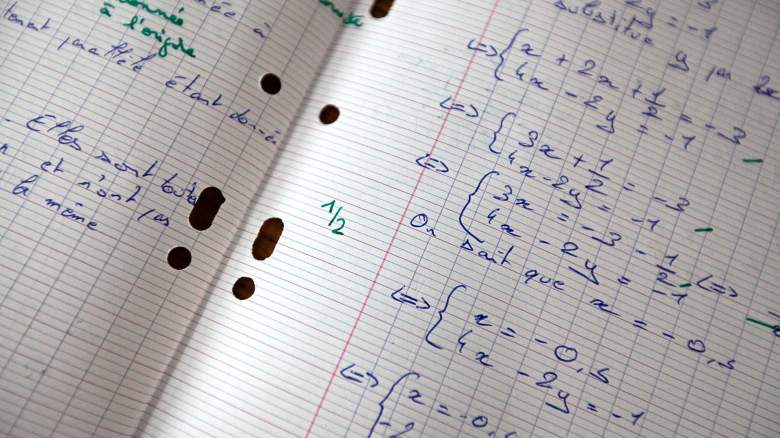
One of math’s biggest mysteries could now be solved, thanks to the power of artificial intelligence.
A Mathematician Is Working Towards a Major Breakthrough With an AI Tool

Over the past few years, artificial intelligence has received widespread criticism. However, a mathematician recently revealed he may have overcome a monumental mathematical problem by harnessing the power of AI.
If the breakthrough is true, it’s something that math experts throughout the years could never do.
The mathematician, Levent Alpöge, publicly proclaimed on November 20 that he has been working toward a proof for the Riemann hypothesis. He’s been using an AI chatbot called Claude, created by the tech company Anthropic.
“I believe I have, working with Claude, discovered a proof of the Riemann Hypothesis,” Alpöge shared in an official statement. “In fact, the method easily extends much further, resolving the so-called Generalized Riemann Hypothesis, and I expect, with more time, the Extended Riemann Hypothesis too. Claude and I have also formalized the arguments without assumptions.
“It is natural to feel that this is an end, in my case a loss of a principal guiding light, but what I saw during the course of progress so amazed me that I believe it is one dawn across science of something far greater,” he added.
What is the Riemann Hypothesis?

While many complex math problems have been solved over the years, the Riemann hypothesis continues to elude even the most determined experts. Even after all this time, it remains one of the biggest problems that mathematicians strive to solve. Even the Clay Mathematics Institute offered a $1 million reward to the person who solves it.
Now, a solution could very well be within grasp thanks to AI.
“The Riemann hypothesis was first proposed in 1859 by the mathematician Bernhard Riemann. It claims that the locations of the prime numbers along the number line, which appear random at first blush, are actually determined by an intricate, meaningful order,” Scientific American writes.
If Alpöge truly manages to pull this feat off, it will change the way mathematicians solve equations in the future. On top of that, Scientific American believes AI tools will have long-reaching effects stemming from Alpöge’s strategy.
“After a year of watching LLMs surpass one math benchmark after another, there is no more staggering achievement it could possibly reach,” the outlet writes. “A machine may have just solved a problem that the smartest people on the planet all agreed they were nowhere close to figuring out. As Massachusetts Institute of Technology mathematician Andrew Sutherland once put it to me: ‘An AI that can prove the Riemann hypothesis is not one I’d want to meet. If that happens, mathematicians having jobs will be the least of our problems.'”


One Mathematician Strives to Solve a Long-Held Hypothesis With an AI Chatbot