


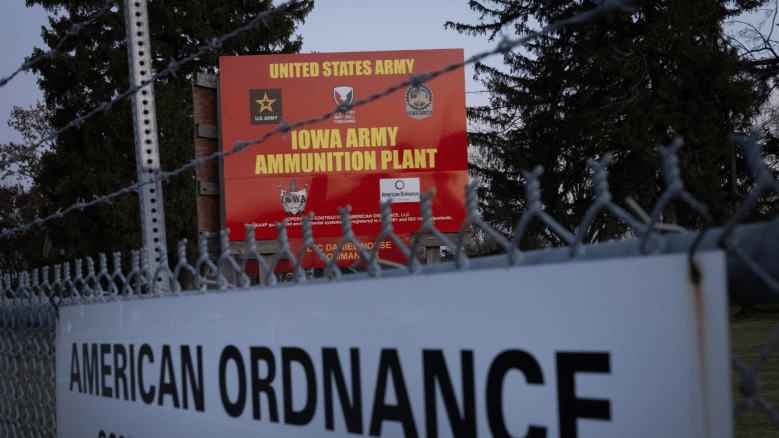
A filing by the U.S. Department of Justice indicates the U.S. army plans to go forward with its plan to detonate 5 tons of lead-containing explosives in Middletown, Iowa no later than Tuesday, November 24, Iowa Capital Dispatch reports.


The outlet published the update in the early morning hours of Sunday, November 22, around two days after a federal appeals court temporarily blocked the permit in response to an emergency request from two environmental groups in the state.
The November 22 report says the army has not released an official schedule or impact maps. The material the army plans to detonate, or explode, is lead azide. Science.org explains lead azide is a “primary explosive,” making it very sensitive to physical impact or other sudden stimuli.
The material’s extreme sensitive is why the army says it’s necessary to facilitate a planned, intentional explosion before the material detonates spontaneously. The outlet says the army has had close to 10,000 pounds of the material stored at an Iowa ammunition plant for around 20 years, submerged in a mixture of ethanol and water.
The report goes on to say the reason the explosives suddenly present a crisis is because proper storage conditions have not been maintained. It says the material has become dangerously sensitive to shock and friction because over time, it has recrystallized after partially dissolving into the storage solution. The piece calls the situation a “grievous” and foreseeable error, a “not what you are supposed to allow to happen.”
The U.S. Army Says Immediately Detonating the Lead Azide is the Only Option
The Iowa Capital Dispatch report says the Department of Justice insisted in a court filing that delaying the planned explosion would be dangerous, writing, “An uncontrolled detonation of nearly five tons of primary explosive would endanger soldiers, contractors, and the surrounding communities, all without many of the protective measures meant to minimize the risks from the blast—harm that cannot be undone” and ““The environmental and health interests Petitioners seek to protect plainly are better served by a controlled detonation than by an uncontrolled explosion.”
ABC’s WQAD8 spoke with concerned Middletown citizens. “I’m worried about my property, and the lead being on the ground, and my animals and stuff,” one man told the station.
U.S. Army Issued Public Advisory About the Detonation on November 15, Which Some Say Was Not Enough Advance Warning
On November 15, the U.S. army issued a public advisory informing citizens of the planned explosion just five days ahead of when it was scheduled to take place. Many people felt this wasn’t enough time for residents to make plans to evacuate.
The advisory states, “Residents will be asked to vacate the area from 8 a.m. to 2 p.m. local time, and dust is expected to linger for no more than one hour, depending on wind speed.”
They also warned the explosion will cause “a dust plume that will contain some lead.”
Iowa public radio says the army stated they cannot chemically neutralize the material because “The chemical neutralization process requires significantly more ‘hands-on’ time and physical manipulation of the drums by personnel over a prolonged 7-to 22-day period, drastically increasing the probability of accidental, fatal detonation during handling.”















U.S. Army Plans to Go Forward With Lead Detonation by November 24, DOJ Says