


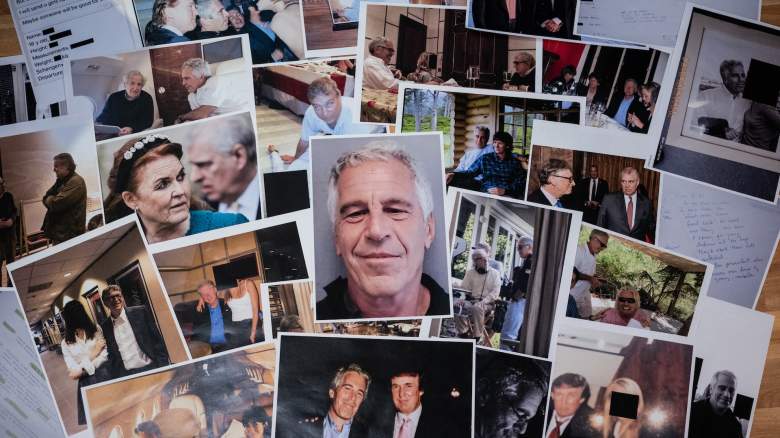
On August 10, 2019, Jeffrey Epstein was discovered unresponsive in his jail cell in the Manhattan Correctional Center.
While the official cause of death was reported to be suicide, speculation that he was murdered in prison has continued to grow.
Now, a new report from a respected forensic scientist refutes the results of Epstein’s initial autopsy, claiming that all the evidence indicates that Epstein did not take his own life.
Freeman: Jeffrey Epstein Died Via Homicide, Not Suicide
The New York Times reports that Dr. Michael Freeman, a renowned forensic scientist and editor-in-chief of the Journal of Forensic and Legal Medicine, has studied the evidence of Epstein’s death and come to a strikingly different conclusion.
Freeman, an expert in examining bias and error in death investigations, was hired by the late convicted pedophile’s brother, Mark Epstein — who has long believed that his brother did not die by his own hand. As a result, Freeman was granted rare access to the autopsy file.
After examining the evidence the file contains, Freeman agreed that something wasn’t adding up — particularly when he saw a photo of Epstein’s neck that seemed to refute official claims that he’d hung himself.
As he told the Times, his first response upon seeing the photo was, “Wait a minute, that doesn’t look like a hanging mark.”
‘Homicidal Strangulation’
On Monday, November 16, Freeman presented the findings of his year-long study at the Middle Temple, a London legal society, contending that that Epstein’s injuries “are most plausibly explained by homicidal strangulation.”
As The Times reported, Freeman said there was “zero chance” that Epstein took his own life.
According to Freeman, the noose hadn’t left a smooth consistent line on his neck, as would have been the case had he hung himself. Instead, he stated during his presentation (via CNN), “The ligature marks are most consistent with homicidal strangulation from behind, most likely using a narrow knotted fabric ligature.”
That, he said, was consistent with strangulation. Per the Times, Freeman is looking to publish his findings in a peer-reviewed journal — but has so far been rejected.
He also said that the evidence he saw rejects the findings of the medical examiner, insisting that wounds and marks on Epstein’s body clearly indicate there had been a struggle prior to his death.
“The pattern and distribution and multitude of injuries are not explained by a suicidal hanging,” Freeman stated in his presentation.
Medical Examiner ‘Stands By’ Initial Results
In a statement to CNN, the New York City Office of Chief Medical Examiner said that it “stands by its determination” that Epstein had hung himself.
That, however, is not good enough for Mark Epstein, who said he’d only learned of Freeman’s findings on November 16, and found the forensic scientist’s findings to be “absolutely” convincing.
Speaking with CNN, he insisted that Freeman’s findings warranted that authorities revisit the case, treating it as an unsolved homicide.
“They should open up a full-scale murder investigation, which was never done,” Epstein said. “We now know he was murdered. We now know he could not have committed suicide.”









Michael Freeman: Forensic Scientist Claims Autopsy Photos Show Jeffrey Epstein Was Killed